Author: Yolanda Sánchez, Dangerous Goods Safety Adviser and Quality Manager at XGL Logistics. In this article we look at chemical storage and its importance in today’s logistics.
The storage of chemical products is one of the most critical — and often least visible — points in the chemical industry supply chain. When we think about chemical safety, we tend to think of industrial processes or the transport of dangerous goods. But what happens in the warehouse? Poor storage management can create risks for people, the environment and the facilities, as well as operational disruptions that affect the whole supply chain.
In this article we review the main aspects to consider to ensure safe storage that complies with current regulations.
Classification and labelling of substances
The starting point is the correct classification of substances under the REACH and CLP Regulations, the European regulatory framework for protecting human health and the environment throughout the supply chain. The CLP Regulation, in particular, sets out the criteria for identifying the hazards of each product and determining the conditions for handling, storage and signage.
In day-to-day warehouse operations, correct labelling reduces the risk of errors during handling or when preparing shipments. And in an emergency, quick identification through hazard pictograms can be decisive.
This information is complemented by Safety Data Sheets (SDS), which accompany every hazardous substance and set out, in 16 sections, the associated risks, safe handling measures and possible exposure scenarios.
Segregation and chemical incompatibilities
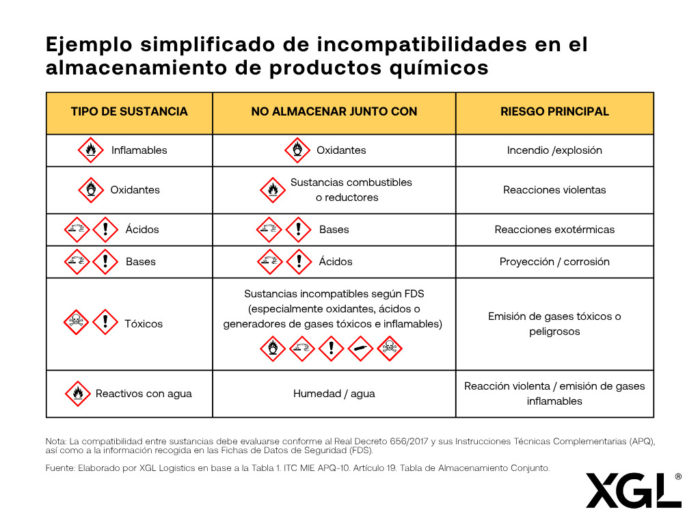
Not all products can be stored together. Certain combinations can cause dangerous reactions, release gases or increase the risk of fire. That is why it is essential to segregate by chemical family and comply with the storage ratios set out in Spanish Royal Decree 656/2017 and the corresponding Complementary Technical Instructions (ITC) for each type of APQ facility.
Knowing chemical incompatibilities and planning storage space carefully are two of the keys to minimising these risks.
Technical requirements for facilities
Storage facilities must meet the specific technical requirements of the APQ regulations, Spain’s rules on the storage of chemical products. For substances in mobile containers — drums, jerrycans or intermediate bulk containers (IBCs) — ITC MIE APQ-10 regulates aspects such as ventilation, containment systems, fire protection and the layout of storage areas.
These facilities are also subject to periodic inspections by authorised inspection bodies that verify compliance with the required safety conditions.
Handling and incident management
Handling operations are another sensitive point. Activities such as decanting, repackaging or refilling require specific procedures, suitable equipment and trained staff to prevent leaks, spills or accidental exposure.
Incidents can arise along the logistics chain, such as damaged containers, loss of tightness or goods that need repackaging before distribution. With more than 20 years managing chemical logistics operations, at XGL we know these situations are not unusual: they require the ability to act immediately, suitable facilities and qualified staff to resolve them without interrupting operations.
Traceability and logistics control
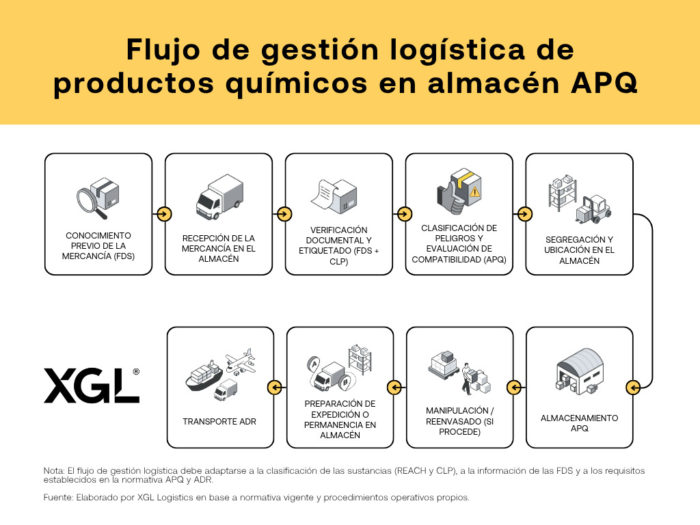
Knowing at all times where each batch is, what condition it is in and what its characteristics are is essential for planning operations well and keeping thorough control over stored products.
Logistics management systems bring all this information — labelling, safety data sheets, technical documentation — into a single control flow that gives full visibility across the whole chain.
Staff training and regulatory supervision
The human factor remains one of the pillars of safety in these operations. Staff who handle or manage these goods must have specific, up-to-date training in both regulations and safety and emergency procedures.
Regulations also require the appointment of a Dangerous Goods Safety Adviser for dangerous goods, a key role in supervising compliance and continuously improving procedures. At XGL Logistics we have several certified advisers within our own team, which strengthens operational control and preventive risk management.
Conclusion
In an environment where supply chains are increasingly complex, safe chemical storage requires a professional approach: regulatory knowledge, suitable facilities and real operational experience.
Working with a specialist logistics operator such as XGL Logistics allows companies in the sector to ensure their products are managed to the required safety standards, without losing efficiency or operational continuity.
Do you have questions about how to manage the storage of your chemical products? Contact us and we will advise you.